

Introduction
Palm Sunday is one of the most joyful and visually dramatic moments in the Christian year. A crowd lays down cloaks and branches. A king arrives — not on a warhorse, but on a donkey. The people shout Hosanna! — “Save us!” It is a scene of spontaneous, embodied, communal worship.
What is striking is how differently communities around the world have received and expressed this one moment. The same story has taken root in dozens of cultures and blossomed into celebrations that are uniquely, beautifully local — woven palm fronds in Manila, towering flower-covered branches in the Polish mountains, solemn candlelit processions through the streets of Seville, palm-leaf crowns in Addis Ababa, drumming bands in Port-au-Prince.
This page explores five of the most distinctive cultural expressions of Palm Sunday from around the world. As with all cultural traditions, we receive them with both gratitude and discernment — celebrating what is genuinely beautiful and true, and gently noting where a tradition may need to be reframed for Christian worship.
A guiding question: Does this expression help us welcome Jesus more fully — with our whole selves, our creativity, our community, and our bodies?
The waving of palaspas on Palm Sunday is one of the most vibrant and heart-stirring traditions in Filipino Catholic life. Filipinos bring intricately woven palm fronds to church to be blessed by priests, echoing the welcome Jesus received in Jerusalem. These woven palms are not your standard branches — through the skilled hands of artisans, coconut palm fronds are transformed into birds, flowers, hearts, crosses, swords, and spirals. Daily Tribune
The tradition goes far beyond a simple biblical replay. It is a celebration of indigenous artistry, a display of cultural resilience, and a living, unbroken chain of faith that has triumphed through centuries. Daily Tribune
After the blessing, the palaspas are taken home and pinned on doors, windows, and entryways — believed to symbolize the welcoming of Jesus Christ into the home. Some also associate the blessed palm with protection against misfortune — a folk belief that, as Christians, we would gently reframe: not as a magical charm, but as a sign of Christ’s lordship over the household, a visible declaration that this home belongs to Him. Vogue Philippines
The gift for our worship: The idea that worship involves artistry and craftsmanship. The palaspas is not bought off a shelf — it is woven, shaped, and offered. Our churches can invite people to bring handmade expressions of welcome to God: woven, drawn, built, or crafted.
Key Scripture: John 12:13 “They took palm branches and went out to meet him, shouting, ‘Hosanna! Blessed is he who comes in the name of the Lord!'”
In Ethiopia, Palm Sunday is not called Palm Sunday at all — it is called Hosanna, named after the cry of the crowd that greeted Jesus in Jerusalem. Ethiopian Orthodox Christians gather before dawn at cathedrals across the country for a night-long service of liturgy, chants, and hymns that culminates in the feast of the morning. ENA
Clergy distribute blessed palm branches to the congregation, and believers weave these into rings and small crosses, which they tie around their heads or wear as crowns. Palms have long been a sign of victory, success, and glory — and the palms worn on the head serve as a reminder that through Christ’s victory, believers too can gain this victory and achieve everlasting life. Borkena
Both the Ethiopian Orthodox Tewahedo Church and the Ethiopian Catholic Church hold solemn and vibrant ceremonies, uniting Christians of different denominations in spirit and devotion, with traditional prayers, hymns, and centuries-old liturgical rituals. Fanamc
There is nothing here that requires discernment — this is a deeply rooted, thoroughly Christian tradition that has been celebrated in Ethiopia since the earliest centuries of the faith.
The gift for our worship: The name Hosanna — not just as a word we sing, but as a cry of the whole person. And the idea of wearing faith on your body: a crown of palm on your head as a physical act of submission to Christ as King. Our churches can reclaim Hosanna as a shout, not just a hymn title.
Key Scripture: Matthew 21:9 “Hosanna to the Son of David! Blessed is he who comes in the name of the Lord! Hosanna in the highest heaven!”
Holy Week in Seville — Semana Santa — is one of the most spectacular religious celebrations in the world. It begins on Palm Sunday with the procession of La Borriquita (“The Little Donkey”), a float depicting Jesus’ triumphal entry into Jerusalem. This is the first of dozens of processions that will wind through the city’s narrow streets over the following week, each one organized by a cofradía (brotherhood), some of which have existed since the 16th century. Viory
The processions can last up to 13 hours, carried by costaleros — teams of men who bear the enormous floats on their shoulders in complete darkness beneath the float, seen by no one, serving in hidden sacrifice. Crowds of thousands line the streets; some weep, some sing, some simply stand in silence. EOTCMK
People carry olive branches blessed at the Palm Sunday Mass, and the whole city dresses formally for the occasion — women in pastel shades, men in suits — as a collective act of honor and reverence. Keraneyo MedhaneAlem
The gift for our worship: The public and embodied nature of worship. Faith that takes to the streets. The hidden sacrifice of the costaleros — serving in anonymity, unseen, for hours — is a powerful image of what it means to carry Christ’s cross. Our churches can ask: how do we take our worship outside our four walls?
Key Scripture: Luke 19:37–38 “The whole crowd of disciples began joyfully to praise God in loud voices… ‘Blessed is the king who comes in the name of the Lord!'”
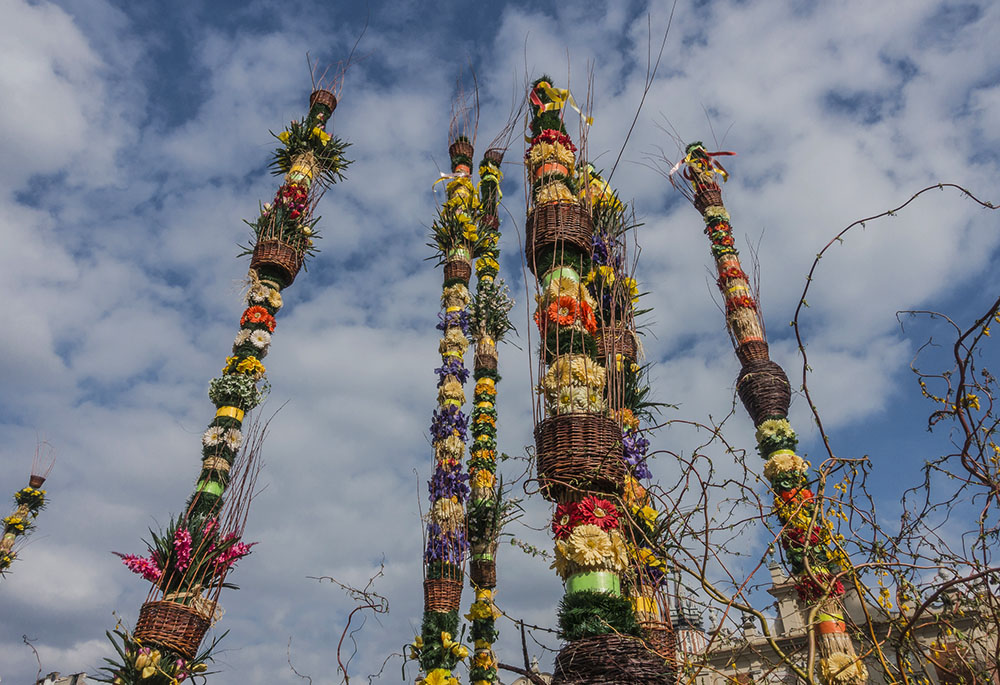
Poland faces a practical problem on Palm Sunday: palm trees don’t grow there. Rather than simply importing palm fronds, Polish communities responded with extraordinary creativity — crafting elaborate decorative palmy from willow branches, dried flowers, ribbons, fir sprigs, and colorful tissue paper. Wikipedia
These handmade palms are taken to church on Sunday to be blessed and then displayed in homes throughout the Easter season. In some regions of southern Poland, communities hold annual competitions for the tallest and most beautiful palm — some reaching over 20 meters high — accompanied by fairs, folklore performances, and crafting workshops. Agnesinversiones
The palms symbolize the victory of spring over winter, and — in the Christian reframing — the victory of life over death. They are made by hand, often by whole families together, adding warmth and personal meaning to the celebration. Catholic Digest
There is a folk element worth noting: some older customs associate the blessed branches with good luck in the fields. As Christians, we receive the beauty of the tradition — the creativity, the communal making, the blessing — while understanding the blessed branches as a symbol of resurrection hope, not a magical object.
The gift for our worship: The theology of adaptation. When the original isn’t available, you don’t give up — you create something new, equally beautiful, from what your own land provides. This is inculturation at its most joyful. Our churches can ask: what do we have, right here, that we can offer to God?
Key Scripture: Psalm 96:1 “Sing to the Lord a new song; sing to the Lord, all the earth.”
In Haiti, Palm Sunday celebrations are a vivid mixture of Catholic tradition and local cultural expression. Processions move through communities accompanied by travelling bands playing drums, maracas, and trumpets — a joyful, full-bodied welcome to Christ the King that fills streets and neighborhoods with sound and movement. Baltimore Chronicle
Haiti’s religious landscape is complex: Haitian Vodou exists alongside Catholicism in ways that are sometimes intertwined. For Haitian Christians, Palm Sunday is a moment of clear, joyful proclamation — Jesus is King — celebrated in the rhythms and instruments of their own culture. The drums are not Vodou drums here; they are the sound of a community that has learned to worship God in its own voice.
The gift for our worship: Rhythm as worship. The body as an instrument of praise. The entire community — young and old, in the streets, not just in a pew — joining the procession. Our churches can make space for percussion, movement, and processional worship as genuine acts of faith, not entertainment.
Key Scripture: Psalm 150:3–5 “Praise him with the sounding of the trumpet… praise him with tambourine and dancing… praise him with the clash of cymbals!”
Some suitable songs
- Seu Shearim Lift up your heads
Original language: Hebrew
Direct reference to Psalm 24 — the King is coming - Piroozi Hast Azadi Hast There is Victory, There is Freedom
Original language: Persian
Entry theme — victory - Haye aan ammaanno Let us praise Him!
Original language: Somali
Joyful communal praise — perfect for a procession - Jalali Yesu Jesus Is Glorious
Original language: Urdu
Glorify Christ as King
A note on how we approach these traditions
Palm Sunday is one of the most joyful days in the Christian calendar — and as this page shows, communities around the world have found extraordinarily creative ways to celebrate it. From the intricate woven palms of the Philippines to the overnight vigils of Ethiopia, from the solemn processions of Seville to the handcrafted flower bundles of Poland, each tradition is a unique act of welcome: the King is coming, and we are preparing to receive him.
What strikes us most about the traditions on this page is how little theological discernment they require. Unlike some cultural expressions around death and remembrance, Palm Sunday celebrations are — almost without exception — already Christian at their core. They are not practices borrowed from elsewhere and reframed; they are the church, in its many forms, doing what the church has always done: going out to meet Jesus with whatever it has in its hands.
Where folk beliefs have attached themselves to a tradition — such as the idea that a blessed palm branch brings protection or good luck — we gently note that for Christians, the blessed branch is a symbol of Christ’s lordship, not a magical object. The blessing points to the One who blesses, not to the object itself.
Beyond that, our invitation on this page is simple: look at how the world welcomes its King, and ask what your own community can bring.
Every culture represented here has something to teach the rest of the body. The Filipino brings artistry. The Ethiopian brings the ancient cry of Hosanna. The Spaniard brings scale and sacrifice. The Pole brings creativity and adaptability. The Haitian brings rhythm and the whole neighborhood.
Together, they paint a picture of Revelation 7 — the great multitude from every nation, holding palm branches, crying out before the throne.
That picture begins here, on the Sunday before Easter, in communities all over the world.